Babs Help 2 Sleep - $47 - Instant Access - Self-Paced
The Independent Sleep Method
Your little one finally sleep through the night. You never have to leave the room to get there.
You rock your little one until those eyes are heavy. You wait. You hold your breath and lower your little one into the cot.
The second that little back touches the mattress, eyes open. Wide awake. Again.
So you start over.
Or maybe it's 2am and you've already been in three times. You know something needs to change.
But the moment you stop and your little one cries, you freeze. Nobody has ever told you what to do in that moment.
So you give in. Nothing changes.
You've tried earlier bedtimes. Later bedtimes. Dream feeds. Wake windows. White noise.
You've Googled every variation of why your little one won't sleep. You've asked in Facebook groups. You've read all the advice.
And somewhere in all of that you found cry it out. Maybe you even tried it, or you considered it, and something in you said no.
Not like that. Not for us.
So here you are. Still rocking. Still feeding to sleep. Still transferring and hoping. Waking up five, eight, ten times a night.
Running on empty. Wondering what you're missing.
"I've tried everything and nothing works.
I need help."
If that's where you are right now, that sentence is the reason this exists.
Maybe you've even said it out loud, I feel like I created this.
Or quietly to yourself: I'm the problem. I must be doing something wrong.
You're not. You just had the wrong information and you've been focused on the wrong problem.
Here's what's actually happening.
Your little one isn't waking up because something is wrong with them. They're waking up because of a sleep prop.
The thing they rely on to fall asleep that they can't provide for themselves.
Every time you rock her, feed her, or bounce her to sleep, you're giving her the one condition she needs to fall asleep.
And when she surfaces between sleep cycles in the night, which all children do every 45 minutes, that condition is gone.
So she cries for it to come back. You come back. It starts again.
The adjustments you've been making, the schedules, the products, the tweaks, none of them touch the sleep prop.
That's why nothing has stuck. You've been treating the symptom, not the cause.
"It's not that your little one doesn't want to sleep. It's just that they don't know how."
Once you understand this, the whole thing changes. And once you have a plan that removes the prop while you stay in the room the entire time, your little one learns what they've been waiting to learn. They learn to fall asleep on their own. You learn that you never had to walk away to make it happen.
The Method.
A step-by-step system that helps your little one fall asleep independently and sleep through the night while you stay present in the room. Not on the other side of a closed door. Not walking away. In the room.
This is the answer to both things at once. Your little one sleeping through the night. You staying close while they learn how.
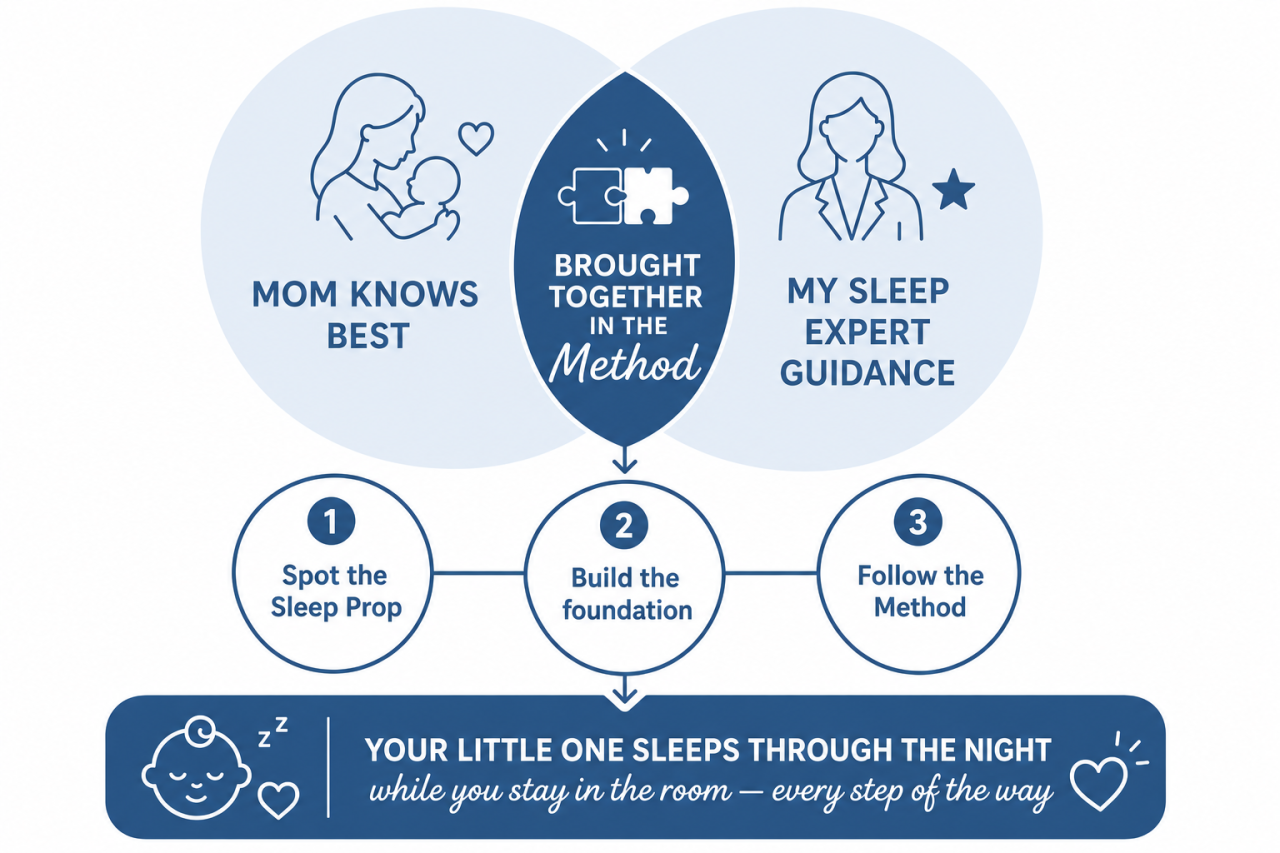
Three phases. In this order. Every time.
Step 1
Spot the Sleep Props
Find the root cause of every night waking. You'll identify exactly what your little one relies on to fall asleep and understand why it's causing every wake-up. Not the schedule. Not the room. The prop.
Whenyou see it clearly, the rest of the method makes sense and you'll finally know what to change. Without this step, nothing else sticks.
Step 2
Build Your Little One's Ideal Sleep Schedule
Create the age-adjusted daily rhythm that makes the method work. A little one who is overtired or undertired at bedtime will fight the process regardless of how well you execute.
This phase builds the schedule for your child's specific age and writes your bedtime routine without props, with the feed as the first step, not the last. Before night one, you have a plan on paper.
Step 3
Follow Your Personalized Sleep Plan and Method
Execute the stay-in-the-room fade-out, night by night. The chair goes beside the crib on night one. You sit. You stay. You use your key phrases.
You know exactly what to do when your little one fusses because you've been told in advance, not left to guess in the dark. Nights two through ten the chair moves gradually. You're still there. And your little one learns.
Each phase depends on the one before it. You cannot skip a step. That's exactly why this works when everything else hasn't.
What about night one?
Night one is the hardest. Not because the method is hard. Because everything is new and you don't know what to expect.
So you get told exactly what to expect.
By night two, most moms already see the first shift. Easier bedtime. Less time to settle. Fewer wake-ups.
The moms who hold steady through night one get there. The ones who weren't prepared don't.
That's the entire reason the First Night Checklist exists.
What's inside.
4 short video modules
- Intro: Why this works when everything else didn't. Mindset and method before night one.
- Step 1: Spot the Sleep Props. Understand what your child relies on and why removing it is the fix.
- Step 2: Build Your Little One's Ideal Sleep Schedule. Create the daily rhythm adjusted to your child's age.
- Step 3: Follow Your Personalized Sleep Plan and Method The full stay-in-the-room fade-out. Chair. Phrases. Night wakings. Exactly what to do including the moment your child cries.
Your companion workbook
- No more guessing when bedtime starts. The sleep sanctuary setup and age-adjusted schedule tell you exactly when, based on your child's age today.
- No more wondering if the routine is right. The prop-free bedtime template is built around your child's specific situation, with feed as the first step.
- No more freezing when they wake at 2am. The night wakings guide and chair progression tell you what to do at each stage, so you're following a plan, not making it up in the dark.
- No more dreading night one. The First Night Checklist walks you through every preparation so you go in ready, not anxious.
- No more questioning whether it's working. The sleep logs track every shift so you can see the progress even when you're too tired to feel it.
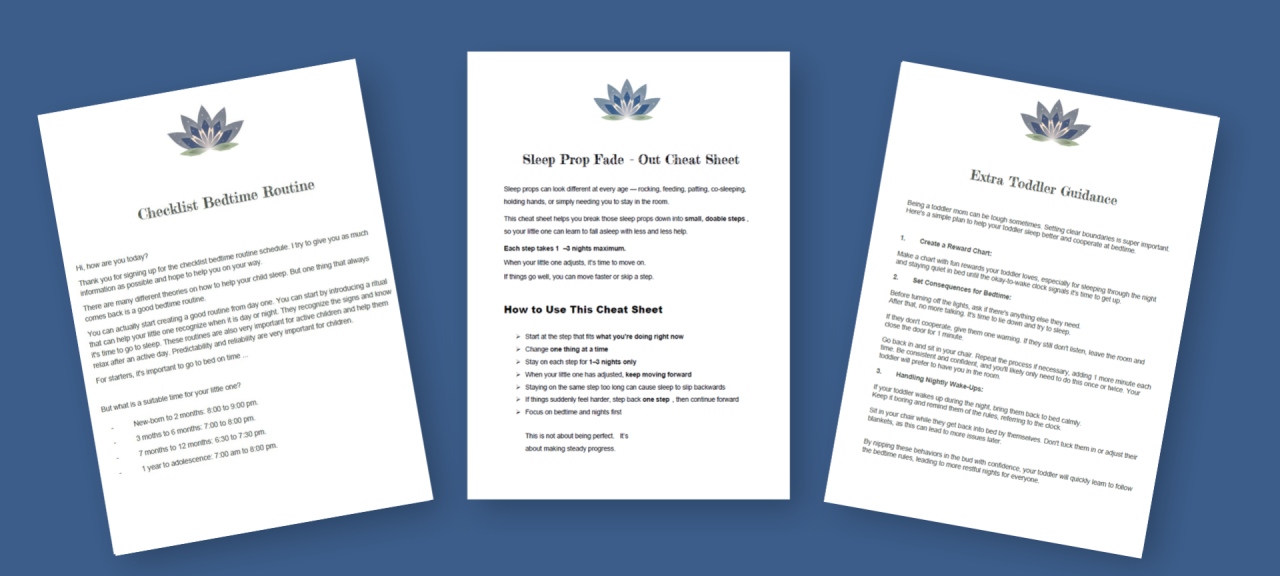
Three bonuses. Each one removes a specific wall.
These aren't extras. They're gap-closers. Each one exists because there's a specific moment in the process where moms get stuck.
Bonus 1: Sleep Prop Fade-Out Cheat Sheet
Breaks down every prop type, rocking, feeding to sleep, co-sleeping, hysterical at the cot, into small doable steps, 1 to 3 nights each. You start at the step that matches exactly where you are right now. You always know what comes next.
Bonus 2: Checklist Bedtime Routine
A complete evening flow that takes 20 to 30 minutes and works the same way every night. Feed as the first step, not the last.
Works whether you do it, your partner does it, or grandma does it. Hand it to anyone and bedtime still happens.
Bonus 3: Extra Toddler Guidance
The pushback looks different and I don't know how to handle it. Reward charts, consequence frameworks, handling the toddler who gets out of bed and tests every boundary. If your little one is 18 months or older, this is the one you'll use.
Most moms see the first shift in 3 to 5 nights, some on night one.
Full results in 1 to 2 weeks when the plan is followed consistently.
This isn't a months-long process. Most families see clear movement, fewer wake-ups, child settling faster, within the first few nights. You've been surviving on broken sleep for months. Three to five nights is close enough to feel real and far enough to be honest. The moms who know this in advance hold steady. The ones who weren't told expect it to be linear and quit. You now know.
About Babs.

Hi, I'm Babs, a Certified Pediatric Sleep Consultant based in Dubai.
I've been helping families with sleep for 7 years, across the world with hundreds of families.
I built this method because I needed it to exist. My daughter's sleep broke me down before I became a sleep consultant. I was rocking, exhausted, not wanting to leave her to cry, not knowing what else to do. I didn't want to choose between her feeling safe and our family getting sleep.
So I found a third path. And over the last 7 years, I've refined the methods I learned during my certification inside real homes at 2am with real families, until every edge case was covered.
The method in this course is the same one I use with every 1-on-1 client. You're getting the same complete plan.
What moms say.
I thought I had tried it all, but nothing stuck. This method pulled everything together step by step. Now nights and naps are amazing and I finally feel like myself again.
Single mom, Boy 6 months
We'd been struggling with our daughter's sleep for months. After only 3 days she was sleeping through the night. I still can't believe it. She is so much happier and well rested. We can't thank Babs enough.
Jill, Girl 9 months
I was honestly so skeptical because I already tried everything, but WOW this really worked. After months of exhaustion, he slept through by the third night. I can't thank you enough.
Boy, 15 months
A few things you might be wondering.
My child is older. Will this still work?
Yes. The method works from 6 months to 9 years. The schedule, timing, and toddler guidance all adjust for age but the core fade-out process is the same. The workbook includes age-specific schedules so you always know exactly what applies to your child.
I've already tried sleep training and it didn't work.
Most moms who say this tried something without the complete picture. A schedule but not the method. A few nights of consistency and then one hard night that sent them back to zero. This is a complete system, sequenced correctly. That's what's different. The plan works because every part works together. You can't skip steps or pick and choose what to follow.
I don't want to leave my child alone.
You don't. The method is built on staying in the room. Your child can see you, hear you, and feel your presence at every step. You're not walking away. You're gradually reducing your involvement while staying close. That's the whole point.
My child is different. This might not work for us.
This is the most common thought before it works. The method is built around your child's specific prop, their age, and your specific situation. It's not one-size-fits-all advice. It's a personalized plan you build inside the workbook.
What if I'm too tired to follow through?
The videos are short. The workbook is fill-in-the-blank. The plan is on paper before night one so you're not making decisions at 2am. You follow the plan. You don't have to hold it all in your head.
Fix nights first. Everything follows.
Nights are where the whole thing starts. Once your little one is sleeping through, you'll have the energy and the confidence to tackle naps. And once naps settle, early waking is the last piece. This course is step one. Get the nights right. The rest follows.
The Independent Sleep Method
One promise. One result. You stay in the room.
4 video modules + companion workbook + 3 bonuses
$47 · one time · instant access
If your little one is still waking you up every night and you're ready to change that, this is the plan.
You've tried everything else. You don't need more tips. You need one complete method from someone who has been in the room with hundreds of families at 2am and knows exactly what to do.